

Published 2026
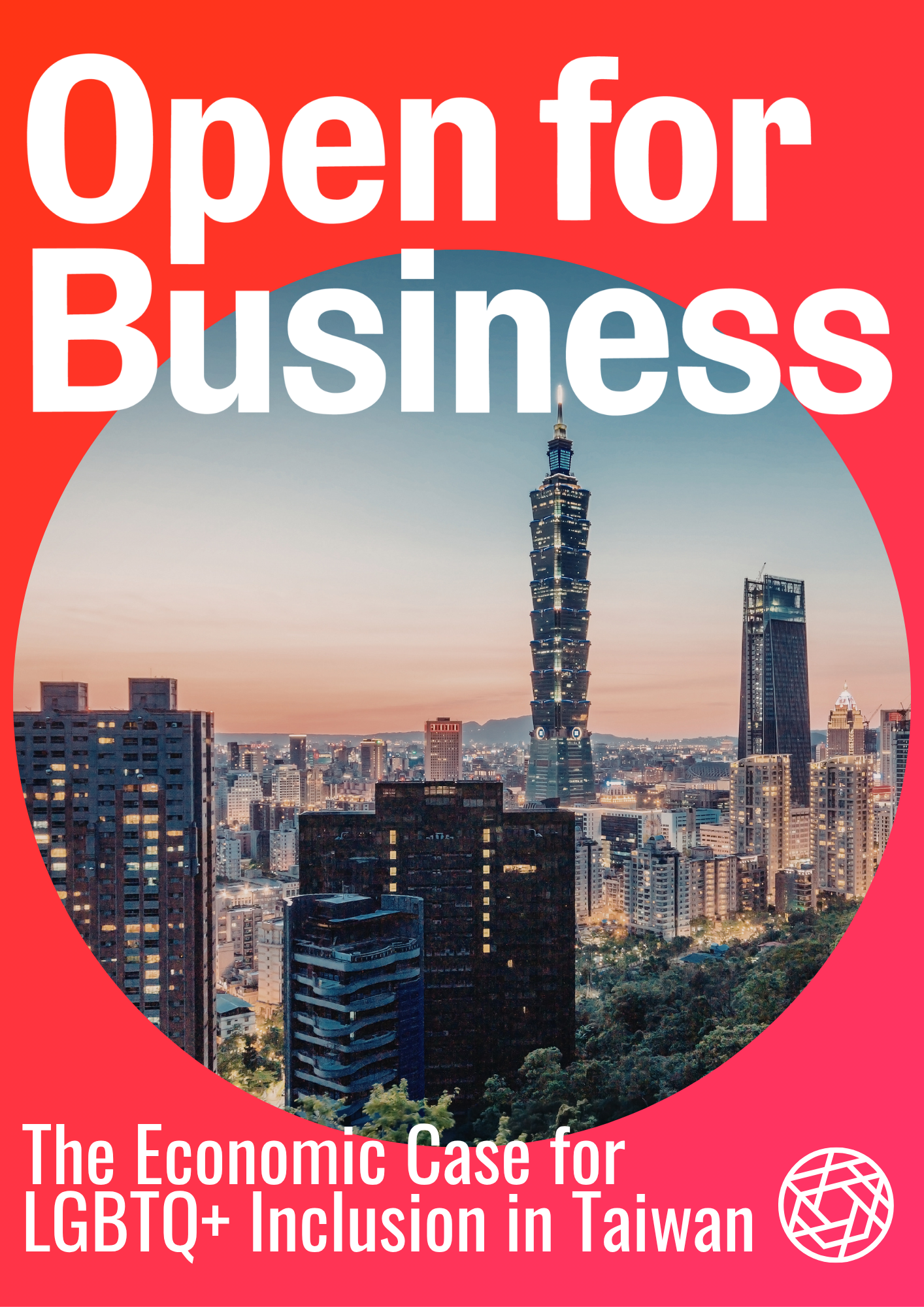
Taiwan has built one of the world’s most competitive economies. Talent is now a critical constraint on sustaining that success. LGBTQ+ inclusion is part of the answer.
Taiwan ranks fourth among 70 economies for competitiveness (2026), second among 196 jurisdictions for innovation (2025), and third among 56 economies for entrepreneurship (2024). Its semiconductor industry also places it at the centre of the global AI economy. Yet its population is ageing and its labour supply is tightening, with a projected shortfall of 480,000 workers by 2030. Sustaining this economic leadership depends increasingly on attracting skilled people, retaining them and enabling them to contribute fully.
Taiwan approaches this challenge with an important advantage. It was the first jurisdiction in Asia to legalise same-sex marriage, and leading employers have made inclusion part of their approach to recruitment, workplace culture and employee benefits. Yet this progress has not eliminated the discrimination and barriers LGBTQ+ people experience in their daily lives. Uneven workplace support and remaining gaps in legal recognition can affect their health, career opportunities and decisions about where to build a future. For Taiwan, this means losing some of the contribution of people its economy needs.
We estimate the annual economic burden associated with LGBTQ+ exclusion in Taiwan at NT$39.02–107.05 billion (US$1.23–3.38 billion), equivalent to approximately 0.14–0.38% of Taiwan’s 2025 GDP. This estimate captures two ways exclusion limits that contribution: excess ill-health and stigmatisation associated with depression and HIV/AIDS, and lost earnings linked to the LGBTQ+ wage gap and over-representation in non-standard employment.
NT$19.41–58.23 billion (US$0.61–1.84 billion) in the excess burden due to stigmatisation around depression and HIV/AIDS
NT$17.26–36.99 billion (US$0.54–1.17 billion) in earnings lost to the LGBTQ+ pay gap
NT$2.34–11.83 billion (US$0.07–0.37 billion) in earnings lost to over-representation in non-standard work
This is not a forecast. It is what the Taiwanese economy, its employers and its health system are absorbing today.
Inclusion as economic resilience
Taiwan already has important foundations to build on. Marriage equality has helped some LGBTQ+ people see a future in Taiwan, according to interviewees, while employers describe how inclusive cultures strengthen recruitment and retention. These experiences extend across multinational firms, domestic businesses and traditional industries. Yet the benefits remain uneven: workplace support varies, and barriers affecting family formation and legal recognition can influence whether people are able to build long-term lives and careers in Taiwan. Business leadership exemplifies what is possible, while also revealing the limits of what individual employers can resolve.
“We hope the report inspires continued action to ensure that Taiwan remains a place where diversity is valued and inclusion is championed.”
Mark Bailey and Alison Higgins, Co-Sponsors, Global Pride Colleague Community, Standard Chartered
LGBTQ+ inclusion and AI
Taiwan’s semiconductor industry supplies advanced chips used to train and run AI systems around the world. It now has an opportunity to shape the standards by which AI serves people. This is not only an ethics question. It is a question of product quality, legal compliance, talent and export influence.
This is the first Open for Business report to examine the intersection of LGBTQ+ inclusion and artificial intelligence systematically, and Taiwan is the natural place to start. Taiwan’s economic expansion is looking strongly into AI: the 2025 GDP growth figure of 8.68% had considerable influence from the global AI supply chain centred on Taiwan’s semiconductor industry.
The government has adopted an “AI island” national strategy, articulated through the Ten AI Initiatives Promotion Plan, whose aims include cultivating a world-class AI talent ecosystem drawing on local and overseas talent. And in January 2026 the AI Basic Act entered into force, carrying non-discrimination among its founding principles. New cross-country analysis in this chapter shows why that principle is good economics, not just good ethics. We find that legal inclusion tracks closely with the underlying capability to build AI, not merely the ambition to talk about it.
Taiwan’s AI ambitions depend on talent, and the cross-country evidence shows that more inclusive economies tend to have stronger AI capability. The AI systems now entering Taiwan’s workplaces increasingly decide which of those people get hired, assessed and promoted; if those systems inherit past bias, they shrink the pool of talent Taiwan most needs. And the capacity to measure and correct that failure is exactly what the world will need from AI standards, a capacity Taiwan is unusually well placed to supply.
Related reports
2026
2024

2025
2020

2025
2019
