The Investor Guide to Growth Markets
Research Series
Brazil, India, The Philippines, and South Africa
Published 2026
Why LGBTQ+ Inclusion Matters in Growth Markets
Growth markets are often analysed through the lens of demographics, consumption, infrastructure, innovation, and capital formation. They are less often analysed through the quality of inclusion that enables people to participate fully in the economy. That is a missed opportunity.
LGBTQ+ inclusion is not peripheral to growth market competitiveness. It affects how companies attract and retain talent, build trust with customers, manage reputational and regulatory risk, and position themselves with global investors and business partners. In markets where legal protections and social acceptance are still uneven, corporate action can play an especially important role. Companies can create inclusive environments for employees, customers, and communities even where wider society has not yet done so.
This report focuses on LGBTQ+ inclusion through transparency: the extent to which companies publicly disclose their policies, practices, governance structures, workforce data, external partnerships, and market-facing commitments relating to LGBTQ+ inclusion. Transparency does not capture everything about lived experience inside a company. A company may disclose well and still have more work to do. But transparency matters because it turns inclusion from a private claim into public evidence. It allows investors, employees, customers, civil society, and policymakers to see what a company is prepared to stand behind, compare it with peers, and hold it accountable over time.
This third instalment of Open for Business’s Investor Guide to LGBTQ+ Inclusion examines 320 of the largest listed companies across Brazil, India, thePhilippines, and South Africa. It builds on our previous investor guides covering major developed markets, and on our 2021 New Global Champions report, developed in collaboration with Boston Consulting Group (BCG), which examined fast-growing companies headquartered in emerging markets. Together, these studies point to a consistent conclusion: LGBTQ+ inclusion is not only a question of values. It is increasingly a question of institutional quality, market positioning, and long-term competitiveness.
The four markets in this report offer a particularly useful comparison because they sit at different points in the relationship between law, society, and corporate practice.
Executive summary
This report analyses LGBTQ+ inclusion among 320 of the largest listed companies across Brazil, India, the Philippines, and South Africa through how transparent their policies, practices and data are. Then, it identifies significant correlations with business performance. The research reveals that companies showing comprehensive LGBTQ+ inclusion substantially outperform their peers on enterprise value and cash-flow efficiency —without sacrificing profitability— while more than half of the companies across the four markets still report zero transparency about how inclusive they are of LGBTQ+ staff and communities surrounding them. These scenarios create significant first-mover opportunities for companies willing to act.
Business leadership ahead of the law
One of the most significant findings across these four markets is that corporate inclusion practices are frequently running ahead of national legal protections. Companies are building non-discrimination policies, LGBTQ+ employee benefits, and ERG infrastructure in legal environments where Sexual Orientation, Gender Identity and Expression, and Sex Characteristics (SOGIESC) protections are partial, contested, or entirely absent. This represents a form of institutional leadership with real implications for talent, trust, and long-term
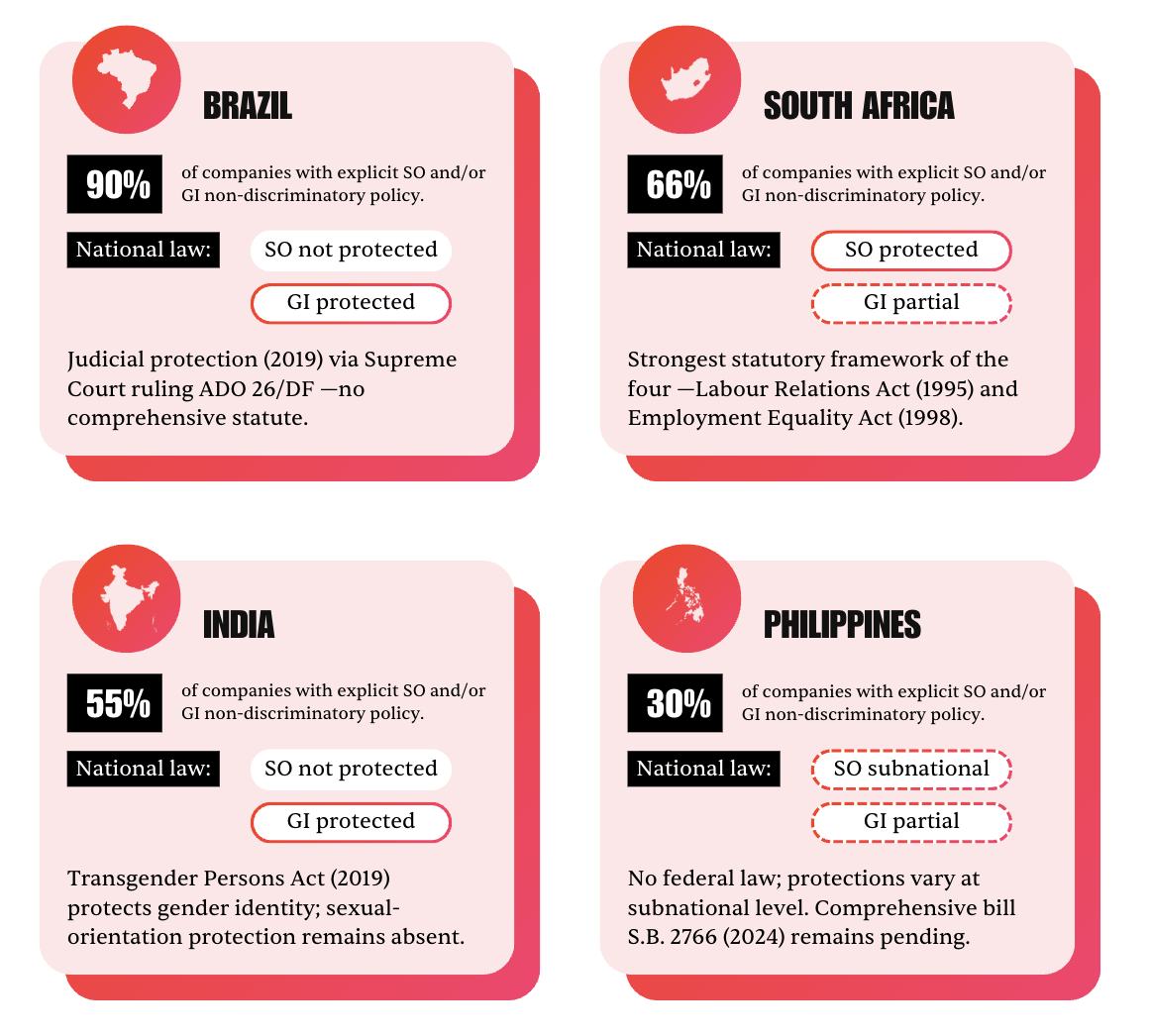
SO: Sexual Orientation
GI: Gender Identity

“The findings are clear: some of the best performing companies in growth markets are becoming global leaders on LGBTQ+ inclusion.”
Ken Janssens, CEO, Open for Business
What is LGBTQ+ Transparency?
LGBTQ+ inclusion transparency refers to the degree to which companies publicly disclose their policies, practices, and data related to LGBTQ+ inclusion. In this report, transparency is measured across eight weighted indicators covering workforce policies, employee benefits, ERGs, workforce composition reporting, board diversity governance, civil society partnerships, public advocacy, and consumer-facing engagement. Each indicator is weighted based on its strategic significance and business relevance.
Rather than assessing internal culture, transparency focuses on what companies are willing to make public. This openness provides investors, employees, customers, and policymakers with clear, comparable signals of a company’s commitment and accountability. Companies that disclose more signal stronger governance, stakeholder engagement, and long-term orientation.
Thus, we use transparency as a way to show how companies are supporting workplace LGBTQ+ inclusion on several dimensions.
As we find in this report, companies across these markets are outperforming not because of reporting on LGBTQ+ policies, but because those policies mean they are building inclusive workplaces.
More from the Investor Guide Research Series