

The Economic Case for LGBTQ+ Inclusion in Uruguay
Published 2025
Interactive City Map, South America - 2025 Edition
See how Uruguay’s City Ratings compares to other cities in the region.
Figure 1: Interactive South America City Map - 2025 Edition. Use Ctrl + scroll (or pinch to zoom) to zoom in and out of the map. Click a city bubble for more information.
The case of Uruguay shows that LGBTQ+ inclusion is not just a human rights imperative, but a tangible driver of national competitiveness.
A progressive legislative framework, combined with active policies for innovation, entrepreneurship, talent retention, and safe tourism, has transformed the country into a regional hub capable of attracting investment, boosting strategic sectors, and reducing brain drain.
The data is clear: greater productivity, more innovation, and a global positioning that translates diversity into an economic advantage. Uruguay proves that inclusion generates returns, not only social but also economic, and sets a precedent for Latin America and the world.
This report includes a summary of Uruguay's achievements in various areas of economic inclusion for LGBTQ+ people in the country, and offers concrete actions to continue on this path toward deeper inclusion, as a driver for its economic and competitive development.
The results of sustained and progressive work toward LGBTQ+ inclusion in Uruguay, as well as its regional economic position, are clear:
LGBTQ+ Inclusion: Uruguay is the Latin American country with the most advanced and comprehensive legislation on trans issues, with a comprehensive federal law. In addition, together with Costa Rica, it is the Latin American country with the highest score on the 2022 Unified F&M LGBT Rights Barometer.
Innovation: It ranks as one of the five Latin American economies with the highest scores in the 2024 Global Innovation Index, and is a regional leader in the areas of Institutions (31st globally) and Infrastructure (48th globally).
Entrepreneurship: According to the Global Entrepreneurship Monitor 2024, Uruguay is the second-best place to start a business among the eight Latin American economies analyzed, and the second-highest Latin American country of 56 economies worldwide.
Brain Drain Reduction: It has achieved a significant reduction in brain drain, reaching a historic low of 3.1 on the Human Capital and Brain Drain Index in 2024, compared to a high of 5.9 in 2007. It is the fourth country with the lowest score in the region.
Talent Competitiveness: It ranked second among Latin American countries in the 2023 Global Talent Competitiveness Index (IGCT).
Tourism: In 2025, it ranked 8th out of 217 countries in the Gay Travel Index as a safe tourist destination for LGBTQ+ people.
Based on its social and economic policies, we find that Uruguay has the following opportunities to advance the economic inclusion of LGBTQ+ people:
Is a regional hub for innovation and has the opportunity to move toward a new era of inclusive innovation from an LGBTQ+ perspective.
Is a hub for entrepreneurship and can advance investment and development in ventures focused on and led by LGBTQ+ people.
Is a regional leader in brain drain reduction and is ideally positioned to enhance brain drain reduction among LGBTQ+ people.
Is a regional example for attracting and retaining trans talent in Latin America, with policies and programs that seek to improve the working conditions of this population group, and which can be expanded to include LGB+ individuals in the country.
Is a driving force for inclusive tourism, due to its global appeal as a safe place that celebrates LGBTQ+ diversity.
The Economic Case for LGBTQ+ Inclusion in Uruguay
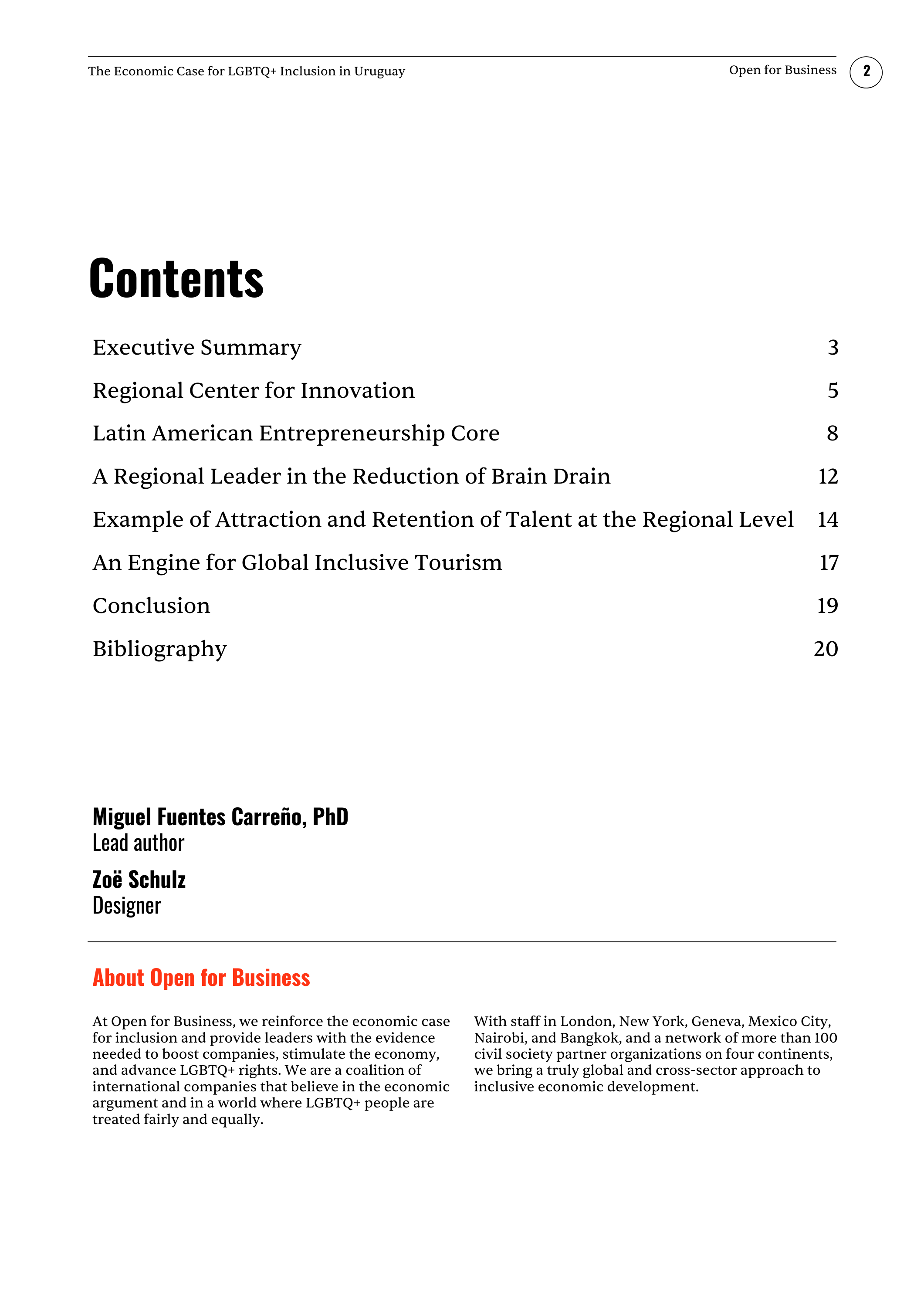
Page 3: Contents
Conclusion: Towards a competitive and inclusive economic future
Uruguay is an example of progress in Latin America, not only for its economic achievements in innovation, entrepreneurship, human capital, and tourism, but also for its deep and sustained commitment to the inclusion of LGBTQ+ people. This report details how its legislation has laid the foundation for a more equitable society, while also focusing on the economic impact that the active participation of LGBTQ+ people can have. Uruguay's potential lies in its ability to translate social achievements into a tangible driver for its economic and competitive development in the region, and even globally.
The key to maximising this potential lies in Uruguay’s efforts to:
Maximize the inclusion of sexual and gender diversity in all innovation processes, institutions, and instruments underway in the country.
Offer targeted capital, financial education programs, and create incubators geared toward LGBTQ+ startups.
Strengthen the enforcement and monitoring of existing labor laws, in conjunction with awareness-raising and training programs on sexual and gender diversity in the public and private sectors.
Expand successful programs for attracting and retaining transgender talent, which can also contribute to attracting and retaining talent from LGB+ people, both foreign and domestic.
Capitalize on its global reputation as a safe and attractive place for LGBTQ+ tourism to also promote the country's natural and cultural resources in ways that contribute to strengthening the national tourism infrastructure.
Uruguay's journey toward LGBTQ+ inclusion is a testament to the positive impact it has had on its economy. By making a sustained effort to fully integrate LGBTQ+ people into innovation, entrepreneurship, and workforce development processes, Uruguay will continue to strengthen its position as a regional leader in human rights. It will also cement its competitive advantage in the regional economy. The economic case for inclusion in Uruguay is synonymous with progress and shared prosperity.
